Change of Operator in Texas (P-4)
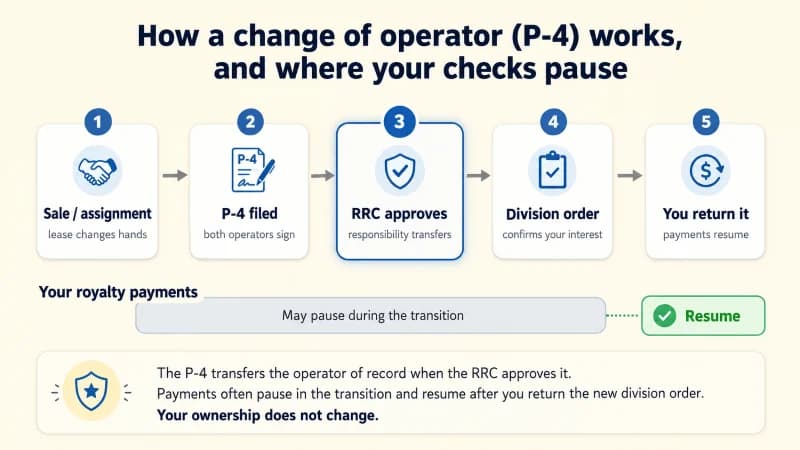
A change of operator occurs when the company operating a well or lease is replaced by another company. In Texas, this change is recorded through an approved Railroad Commission Form P-4, which updates the RRC operator of record for the well or lease.
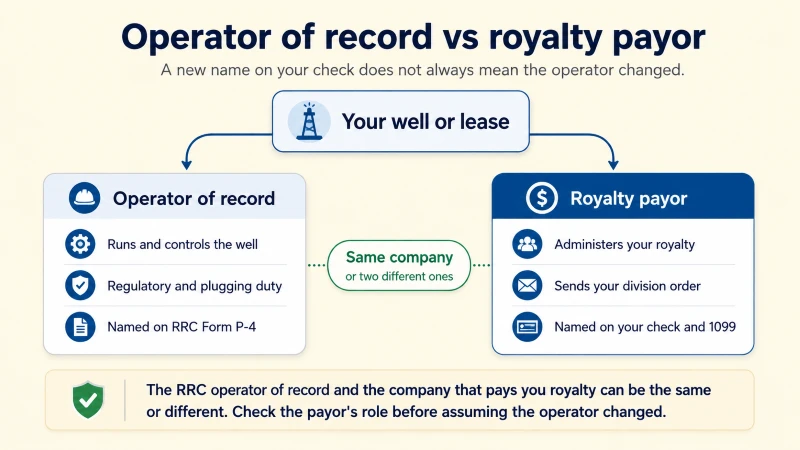
For a mineral owner, this may mean a different company handles operations or royalty payments. The RRC operator and royalty payor are not always the same, and a new division order may be requested if payment responsibility changes.
Owner-First View
What this means for mineral owners
For some owners, a change of operator first appears as a small mystery: the company name connected with the well changes, owner correspondence arrives from an unfamiliar business, or royalty payments begin coming from a different company. However, a different name on a royalty statement does not always mean the RRC operator changed, because the operator and royalty payor may be different entities.
The previous operator may have transferred operating responsibility after a sale, assignment, merger, or change in operating arrangements, and the incoming operator filed a P-4 to become the operator of record. If royalty-payment responsibility also changed, a different company may begin administering or paying your royalties.
The reassuring part is what the P-4 itself does not change. It does not convey your mineral ownership, amend your oil and gas lease, or independently change your decimal interest. It changes the company recognized by the Railroad Commission as responsible for operating the identified well or lease.
If the royalty payor or ownership administrator also changes, that company may send a division order, tax form, address-confirmation request, or other ownership documentation before placing your interest into its payment system.
A change of operator changes who pays you, not what you own
Your ownership, your decimal interest, and your lease terms stay the same.
A new division order usually follows
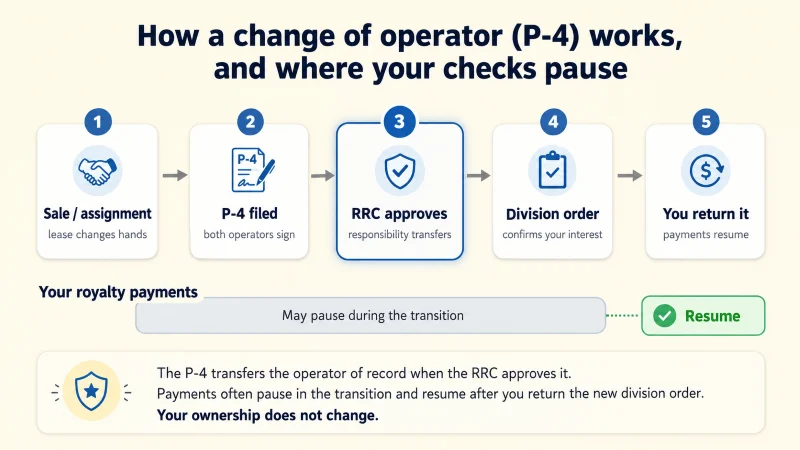
The new operator typically sends one to confirm your interest, and your payments may pause briefly until you return it.
How a Change of Operator Works
When operating responsibility changes because of a sale, assignment, merger, internal reorganization, or other operating arrangement, the Railroad Commission's records must be updated to identify the new operator of record. This is generally accomplished through an approved Form P-4.
The P-4 form
In Texas, the change is made by filing Form P-4 with the Railroad Commission. The P-4 designates the new operator of record for the well or lease. Two conditions matter here. Both the current operator and the new operator generally must sign the filing, so the change reflects an agreed transfer rather than a one-sided claim. In some circumstances, such as when the previous operator is defunct or non-responsive, the Railroad Commission may approve a P-4 without the outgoing operator's signature.
The new operator's RRC responsibility begins upon approval
Filing a P-4 does not immediately make the incoming company the RRC operator of record. The designation becomes effective only when the Railroad Commission approves the filing. Upon approval, the incoming operator assumes responsibility for the physical operation, regulatory compliance, control, and proper plugging of the wells identified in the filing.
Approval timelines vary depending on the Commission's processing workload and the completeness of the filing. In many cases, a properly completed P-4 is approved within a few weeks, though more complex filings or those requiring additional documentation may take longer. The transition period between filing and approval is often when mineral owners experience a temporary pause in royalty payments.
What Changes and What Stays the Same
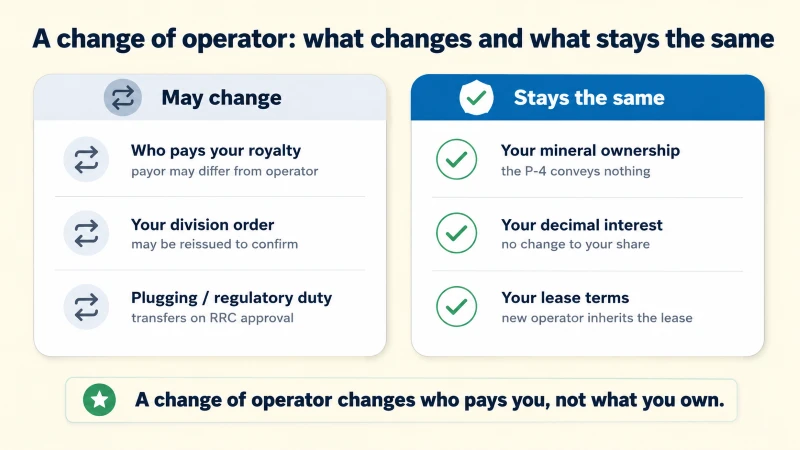
Because owners often fear the worst when their payer changes, it helps to separate what a change of operator actually affects from what it leaves alone.
| Item | Affected by a change of operator? |
|---|---|
| Who pays your royalty | May change. The royalty payor and the RRC operator may be different entities. |
| Your division order | May be reissued if the royalty payor or ownership administrator changes. |
| Your mineral ownership | No change from the P-4 itself. |
| Your decimal interest | No change. |
| Your lease terms | No change. The new operator inherits the lease. |
| Plugging and regulatory responsibility | Transfers only when the RRC approves the change. |
The central distinction is clear: the approved P-4 changes the operator of record. The royalty payor may or may not change, while the P-4 itself does not alter the mineral owner's title, lease terms, or ownership decimal.
Why a Change of Operator Matters to You
The main reason this matters is that it explains a confusing moment and tells you what to expect next. When the operator changes, the new company usually issues a fresh division order to confirm your interest before paying. Returning that division order is generally what gets your payments flowing again under the new operator, so a delay in signing it can delay your checks.
A temporary administrative delay can occur when payment and ownership records are transferred, but a change of operator alone does not by itself authorize the suspension of royalty payments. If proceeds are withheld, ask the payor for the reason, the production months affected, the amount being held, and the documents needed for release.
Unless a lease or other written agreement provides different payment timing, Texas law generally requires first-sale proceeds within 120 days after the end of the month of first sale. For ongoing production, oil payments are generally due by the end of the second month and gas payments by the end of the third month after the month of sale, subject to statutory exceptions.
To see when an operator change or related filing happens on your minerals, Mineral View's Lease Activity tracks regulatory filings on claimed leases, which is a practical way to learn that your operator has changed rather than being surprised by a check from an unfamiliar company.
In rare cases, an operator may go bankrupt or abandon a well without transferring operations. When no successor operator files a P-4, the well may be classified as orphaned. The Railroad Commission maintains a well plugging program to address orphaned wells, and mineral owners in this situation should contact the RRC directly to understand the status of operations on their lease.
A Real-World Scenario
For years, Patricia received her royalty checks from the same operator on her minerals in Reeves County, Texas. Then two checks did not arrive, and when payments resumed, they came from a company she had never heard of.
Her first worry was that something had gone wrong with her ownership. After reviewing Railroad Commission records and contacting owner relations, she learned that operating responsibility had changed and that the incoming company's P-4 had been approved. She also confirmed that royalty-payment administration had transferred to a new payor.
The gap in her checks was the transition period, during which her royalties were briefly held before the new operator took over payments. She received a new division order from the company administering the royalty payments. After comparing the property description and decimal interest with her existing records, she returned the document and her payments resumed. Her ownership, her decimal, and her lease had never changed. Only the operator and the payer had.
Note: This example is provided for illustrative purposes only and does not represent any specific mineral owner or lease.
What to Check
Confirm why your payer changed
If your royalty payment begins coming from a different company, confirm the reason rather than assuming that the operator changed. The company may be acting as the operator, lessee, purchaser, first purchaser, affiliate, or third-party revenue distributor. Compare the name on your royalty statement with the operator shown in Railroad Commission records and contact owner relations when the roles are unclear.
Texas law expressly recognizes that a payor may be an operator, purchaser, or lessee. Mineral View's Monthly Report summarizes your revenue over time, which helps you see when payments paused and resumed during a transition.
To verify whether a P-4 has been filed and approved, you can search the Railroad Commission's online system at rrc.texas.gov. The Commission's Operator Query and well records allow you to look up the current operator of record by lease number, well API number, or operator name.
Review the new division order before signing
If a new division order is sent by the payor or ownership administrator, verify the owner name, mailing address, tax information, property description, effective date, type of production, and decimal interest before returning it. Compare the decimal with your lease, prior division order, title documents, and available pooling or unit records rather than relying only on the previous royalty statement.
Watch for paused or suspended payments during the transition
A brief pause during an operator change is common. If payments stay suspended well beyond the transition, or the new division order never arrives, that is worth following up on with the operator.
Watch for multiple 1099 forms at tax time
When the payor changes mid-year, you may receive separate 1099 forms from each company that paid you during that tax year. This is normal and does not indicate a problem. Keep both forms for your records, because your total reported royalty income for the year will be split across them.
Important
Mineral View can help you see operator changes and activity on your minerals and track your payments over time. For questions about whether a change of operator was properly filed, why royalties remain in suspense, or who is responsible for a well during a transition, contact the Railroad Commission of Texas or consult a qualified Texas oil and gas attorney.
Common Questions
The most common reason is a change of operator. Your original operator likely sold or transferred the lease, and the new operator filed a P-4 with the Railroad Commission to become the operator of record and take over payments. Your ownership did not change. Only the company operating the well and paying you did.
No. A change of operator affects who operates the well and who pays you, not what you own. Your mineral ownership, your decimal interest, and the terms of your lease stay the same. The new operator steps into the existing lease as it is. You may, however, receive a new division order to confirm your interest.
Usually they continue, though they may pause briefly during the transition. Royalties are sometimes held in suspense until the new operator has everything in order and you have returned the new division order. A short gap is normal. A prolonged suspension is worth following up on with the new operator.