Owning mineral rights in Texas can feel like holding a lottery ticket, with value changing based on global oil prices and activity in places like the Permian Basin. If you’ve inherited or recently discovered mineral rights, your first question is likely, “What is this really worth?” It’s an honest question, but in Texas the answer is rarely simple.
You may hear prices per acre or stories of major deals, yet your interest is unique—shaped by geology, legal factors, and time. That’s where a mineral rights value calculator becomes important. It doesn’t promise a final sale price, but it provides a data-driven baseline to judge whether an offer is fair or low.
In this guide, we simplify mineral valuations in Texas, explain how to spot a low offer, and show how modern data can help protect your family’s legacy—so you clearly understand what you are actually holding.
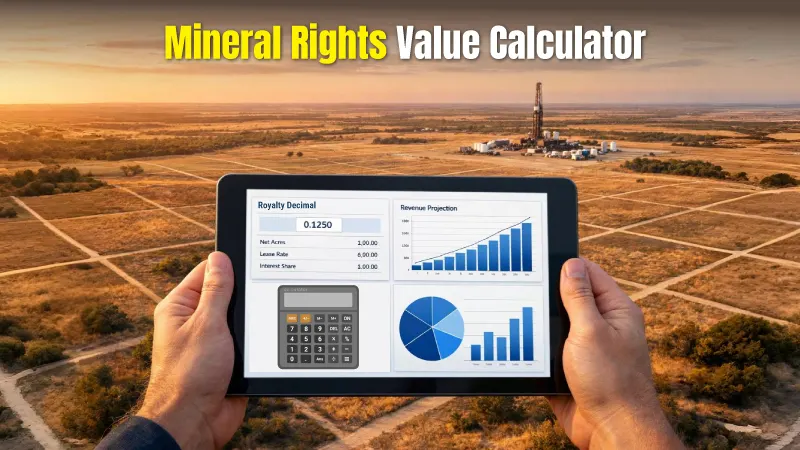
Mineral Rights Value Calculator
Note: The Above calculator provides an estimate based on your inputs and model assumptions. Actual mineral value may vary due to market conditions, prices, geology, and buyer demand. Results are for informational purposes only and are not a guaranteed sale price or formal appraisal.
At its core, a mineral rights value calculator is a financial model. It is created to accept multifaceted variables, such as:
- The Cost of West Texas Intermediate (WTI) Crude
- Your Net Acreage
- Historic Production Figures
On the other hand, when the calculator tells you that your wells are almost approaching their economic limit, then it would be the right moment to sell when there is still some value left in the “proved developed” reserves. Let’s understand with simple mathematics.
Basic Producing Mineral Value Formula
For producing minerals, a simple baseline estimate is:
This is a simplified approach. Advanced calculators use discounted cash flow models for more precision.
MVestimate: Your Advanced Mineral Rights Value Calculator

While pen-and-paper math is helpful for a baseline, the Texas energy market moves too quickly for static spreadsheets. This is where MVestimate—the specialized mineral rights value calculator within the Mineral View platform—changes the game for owners.
Instead of wondering if you used the right discount rate or if your “rule of thumb” multiplier is outdated, MVestimate pulls in live data to give you a clear, professional-grade valuation.
One of the most powerful aspects of this tool is its ability to project your future. It doesn't just look at what you've earned in the past; it allows you to visualize your projected earnings over the next six years.
By analyzing current production trends and operator activity, the tool helps you answer the most critical question: “Is it better to take a lump sum today or hold on for the long-term royalty stream?”
Having this 72-month outlook at your fingertips provides several strategic advantages:
Anticipating Revenue Drops:
Since shale wells have steep decline curves, MVestimate helps you see exactly when your checks might start to shrink, allowing you to plan your household or estate budget accordingly.Valuing “Stacked Pay”:
In many Texas basins, there are multiple layers of oil-bearing rock. This tool accounts for the potential of future wells being drilled in these different zones, which a simple manual formula often misses.Negotiation Leverage:
When you can show a potential mineral buyer a data-backed 6-year projection of your income, you move to a position of “guessing” to a position of “knowing.”
How the Math Works in the Lone Star State
Historically, people used a simple “48 to 72 months of income” rule of thumb. Today, more advanced calculators use something called Discounted Cash Flow (DCF). This method adjusts future income into today's dollars because money received five years from now is worth less than money in your pocket today.
It provides a more realistic estimate of long-term value. Let's understand the discounted cash flow through a formula.
Simplified DCF Formula
While manual formulas are a great starting point for any landowner, the most successful owners use the latest technology to remove the guesswork from their financial future.
Factors That Determine Your Value
You can't just look at a map and pick a price. If a mineral rights value calculator is going to be accurate, it needs to account for the “Big Three” of Texas oil and gas:
The Royalty Decimal:
(This is the most common place where owners get confused. Your lease might say you have a 25% royalty (1/4th), but you only own a fraction of the minerals under the tract. Your “decimal interest” is what actually appears on your check.)
How to Calculate Your Royalty Decimal?
Your royalty decimal determines the percentage of production revenue you receive.
(Net Mineral Acres ÷ Total Unit Acres) × Lease Royalty Rate
If you own:
- 20 Net Mineral Acres
- In a 640-acre unit
- With a 25% (0.25) royalty
(20 ÷ 640) × 0.25 = 0.0078125
That means you receive 0.78125% of the well’s revenue.
The Operator's Reputation:
Who is drilling your well? A “Tier 1” operator like Chevron or Occidental Petroleum often manages wells more efficiently than a small, cash-strapped independent.
The Decline Curve:
Oil wells are not like water wells; they don't flow at the same rate forever. Understanding these specific calculations helps you verify that your royalty statement and division order are accurate before you ever consider a sale.
Common Pitfalls to Avoid
Don't fall into the “County Average” trap. Just because the average price in Reeves County is $10,000 an acre doesn't mean your specific acres are. You could be in a “fault zone” where the geology is broken, or you could be in a “sweet spot.”
Also, watch out for “Pugh Clauses” and “Continuous Development” terms in your lease. These legal “add-ons” can significantly change your valuation because they dictate whether an oil company can hold onto your minerals without drilling. A mineral rights value calculator can tell you the math, but the data from a Lease Report tells you the legal reality.
The Truth About Market Value
At the end of the day, a mineral rights value calculator provides a “theoretical” value. The “true” market value is what a willing buyer will pay you today. However, you should never accept the first offer that hits your mailbox.
Armed with these formulas, you can confidently evaluate the cashflow value of any offer and ensure the royalty percentage being proposed matches the current market conditions. When you have a solid estimate in hand, you can approach multiple reputable buyers and say, “I know what my minerals are worth based on current cash flow and PUD (Proved Undeveloped) locations. What is your best offer?”
From Raw Data to a Final Valuation
Moving from a basic estimate to a farm closing price is a complex process that requires balancing several factors found in your paperwork and the current market. To get an accurate estimate of your overall value, you must look closely at how your specific mineral interest is structured:
Analyzing Your Revenue Stream:
Your current royalty income is the heartbeat of your valuation. By reviewing your most recent royalty statement, you can determine your average monthly income. For producing mineral rights, experts often apply mineral rights value rules—like a 48-to-72 month multiplier—to determine a baseline cashflow value.
Acreage and Ownership Split:
It is vital to distinguish between total acres (the size of the physical land) and your net acres (your actual share after the division order and ownership splits). The total acreage listed on a deed rarely reflects the actual interest you can sell, making the calculation of your specific mineral rights ownership one of the most critical key factors in the math.
The Power of the Lease:
Whether you hold leased mineral rights or non-producing mineral rights changes your strategy. If you have an active lease with a high lease rate and royalty percentage, your value increases because the buyer is guaranteed a specific share of the oil and gas produced. Conversely, non-producing mineral rights are valued based on future drilling potential and market conditions rather than immediate checks.
The Competitive Market:
While a royalty calculator provides a helpful starting point, it cannot account for the individual appetite of a mineral buyer. Because different companies have different views on geology, it is common for other buyers to offer widely varying prices for the same tract. To ensure you aren’t leaving money on the table, you should always solicit multiple offers before signing a deed.
Texas Industry Terms You Need to Know
To use these tools effectively, you have to speak the language of the Landman. If you get these terms wrong, your calculation will be off by a factor of ten.
Net Mineral Acres (NMA):
This is your actual stake. If you own 50% of the minerals under a 100-acre farm, you own 50 NMA.
Net Royalty Acres (NRA):
This is the industry “standard” for pricing. It normalizes your interest to a 1/8th royalty. In the modern Permian, where 1/4th (25%) royalties are common, 1 NMA actually equals 2 NRA.
The Lease Bonus:
This is the “signing bonus” you get when you first lease your minerals. In hot areas like the Delaware Basin, these can be thousands of dollars per acre.
Horizontal vs. Vertical:
A vertical well might pull from 40 acres. A modern horizontal well can have a “lateral” that stretches two miles and pulls from hundreds of acres. This vastly increases the value of your NMA.

Final Words: Taking Control of Your Texas Legacy
Going through the Texas oil and gas industry can be like walking on a minefield, but it is a field of opportunities with the right data. With the knowledge of your Net Mineral Acres, calculating your royalty decimals, and the mineral rights value calculator, you are now no longer a passive viewer but an active manager of your wealth.
In either case, you would sell out at a lump sum today or keep the royalty checks over a long period of time; it should be calculated, not a hunch. Use what is at your disposal, keep track of what operators are doing and keep in mind that in Texas, the surface is only the tip of the iceberg of your property.